Showing posts with label book meme. Show all posts

Thursday, September 26, 2013

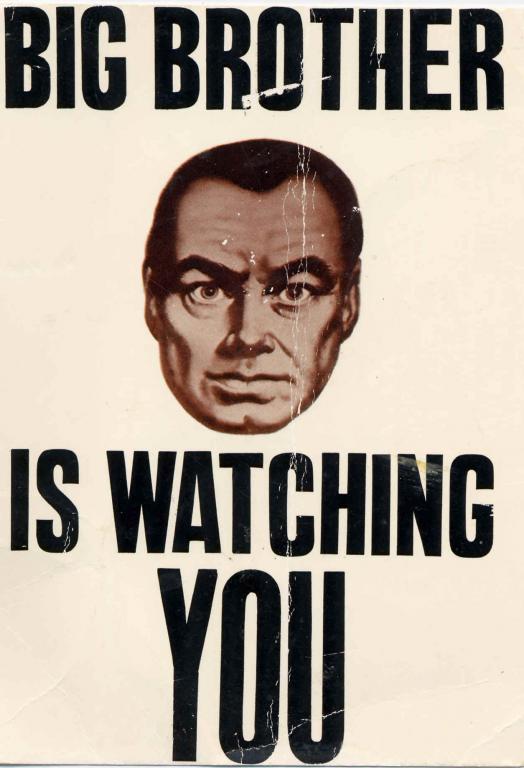
The Classics Club: Nineteen Eighty-Four by George Orwell


.
Nineteen Eighty-Four is one of those classics about which references are always being made, and it seems like everyone has a general idea of the plot, whether or not they've read it.

I knew it was one that I needed to read, but had always put it off, thinking it would be too depressing.  I am so glad I finally read it and recommend it wholeheartedly.  If you've not read it, make this the next book you do read!


While Orwell's dystopia is a terrible place, the book was not so much distressing as thought-provoking.  Like Bradbury's Fahrenheit 451, I also found it disturbingly prophetic.  NewSpeak made me think of the horrible text message shorthand, and the Ministry of Peace was frighteningly similar to the way current governments present the need for war.  As for the Two Minutes Hate. . . How often have we seen a more subtle version of this in the recent past?!

I thought a great deal about how easily people can be "brain-washed" into living in horrid situations or doing vile acts by the government or other powerful institutions--good people, too, with honest intentions who think they are doing the right thing.

I thought about the fact that Orwell wrote this not long after the ending of World War II, and how Hitler's Germany must have been foremost in his mind.

I also thought about the control of history; the victors always write (and sometimes rewrite) history.  This is nothing new, and continues to this day.


 I felt frightened at times, by how similar some of the situations were to today's society.
I was enthralled by Orwell's prose; I had expected it to be dusty, dry, and yet it was alive and relevant.

I felt so much sadness for Winston; he was so real to me that I was emotionally invested in his journey.

I did feel confused by the Party requirements, and struggled to comprehend it fully.  I felt that it would have been better if Orwell had given that explanation early in the book, and more completely.  However, who am I to judge?!  I assume he had an excellent reason for waiting as long as he did, and my lack of understanding  was the fault of the reader, not the writer.


"The horrible thing about the Two Minutes Hate was not that one was obliged to act a part, but that it was impossible to avoid joining in."


"Nothing was your own except the few cubic centimeters inside your skull."

"If the Party could thrust its hand into the past and say of this or that event, it never happened — that, surely, was more terrifying than mere torture and death?"

"The object of waging a war is always to be in a better position in which to wage another war."

"A peace that was truly permanent would be the same as a permanent war. This—although the vast majority of Party members understand it only in a shallower sense—is the inner meaning of the Party slogan: War is Peace."

"All rulers in all ages have tried to impose a false view of the world upon their followers."

"We know that no one ever seizes power with the intention of relinquishing it. Power is not a means; it is an end. One does not establish a dictatorship in order to safeguard a revolution; one makes the revolution in order to establish the dictatorship. The object of persecution is persecution. The object of torture is torture. The object of power is power."


"WAR IS PEACE
FREEDOM IS SLAVERY
IGNORANCE IS STRENGTH"


My explanation of the Classics Club can be found here
and the Classics Club itself can be found here.


Thursday, August 1, 2013

The Classics Club: The Martian Chronicles by Ray Bradbury


.
I was a late bloomer as far as Bradbury is concerned.  While my friends were discovering Bradbury and Vonnegut, I was engrossed in Austen and Shakespeare and Hardy.  The idea of "science fiction" (or "fantasy" for that matter) just didn't appeal to me; I had to grow into it.  As an adult, I came across Bradbury as I began to read the books that it seemed like I "should" read.  Fahrenheit 451 made me an instant Bradbury fan and I've been trying to catch up ever since.  I chose The Martian Chronicles for my latest, knowing it to be one of his most highly regarded and one that I should read sooner than later.

Wow.  No, I'm not being facetious.  It so often made me stop and think, "wow!"--not just for the story he unfolds, but for the amazing way he uses words in this book.  It is stunning.

As most of you know, The Martian Chronicles is a series of linked short stories, telling the story of Mars and it's people, of Earth's exploration and subsequent colonization, and of the end result.  Naturally, I thought a lot about colonization and the harm it has done over the years.  I thought about how often we do things, particularly as a nation, in absolute surety that it is the right thing, only to look back in horror years later.

I also thought about the cyclical nature of things: life in general, civilization in particular.

Bradbury also make me think about the power of words.  His masterful command of the English language, his ability to write volumes in a few sentences, his amazing use of words to set tone and mood. . . it is awe inspiring.

My explanation of the Classics Club can be found here
and the Classics Club itself can be found here.
I thought about "space: the final frontier".  My husband and I have often discussed our belief that our world is such a violent one because there is no longer a "frontier" to explore.  We've discussed how, the roughs and toughs were most often the ones that went off to explore, lightening some of the violence in the "civilized" world.  I was interested to see that for Bradbury, too, the first Earthmen to go to Mars were those types.

I thought about how the line between science fiction and fantasy is so blurred, and about what makes a book "fantasy" or "sci fi".

 I felt the entire spectrum of emotions throughout these stories.  The Martian Chronicles made me sad, melancholic, nostalgic, and happy.  It gave me joy and pain.  I felt love, hatred, embarrassment and hope.  Putting it into words seems to somehow belittle the emotions, but it is all true.  Reading the Martian Chronicles was a highly emotional experience for me, due to Bradbury's ability to create such reality inside his stories.

I know that this will be one that I will reread; it felt familiar immediately, while still feeling new and vaguely threatening.
There were many amazing passages that made me stop, go back and reread.  Here are two favorites.

"He awoke to a tap on his brow.
Water ran down his nose into his lips.  Another drop hit his eye, blurring it.  Another splashed his chin.
The rain.
Raw, gentle, and easy, it mizzled out of the high air, a special elixir, tasting of spells and stars and air, carrying a peppery dust in it, and moving like a rare light sherry on his tongue.
Rain."  --from "The Green Morning"

"There was a smell of Time in the air tonight.  He smiled and turned the fancy in his mind.  There was a thought.  What did Time smell like?  Like dust and clocks and people.  And if you wondered what Time sounded like it sounded like water running in a dark cave and voices crying and dirt dropping down upon hollow box lids, and rain.  And, going further, what did Time look like? Time looked like snow dropping silently into a black room or it looked like a silent film in an ancient theater, one hundred billion faces falling like those New Year balloons, down and down into nothing.  That was how Time smelled and looked and sounded.  And tonight--Tomas shoved a hand into the wind outside the truck--tonight you could almost touch Time. --from "Night Meeting"
Michael Whelan's amazing cover of the Martian Chronicles


Tuesday, July 23, 2013

The Classics Club: The Thirty-Nine Steps by James Buchan


.
Despite never actually having read Buchan's The Thirty-Nine Steps (1915), I was familiar with it as one of the earliest hero-on-the-run suspense-thriller-mysteries, and one that was influential on the genre as a whole.  I take a historical interest in my favorite genre, and felt I needed to read it.


What a grand adventure!  I had to think that this is the precursor to those heroes so prevalent in today's thrillers (you know, the ones that get out of bed, get beat up, shot, drowned and beat up again all before they take the dame back to bed) but yet it didn't seem hokey.  Hannay was just this side of believable, like a hero should.  He was crush-worthy for the female reader and role model-worthy for the males.

The action of this book takes place just before the Great War starts (but is written after the War started, so it is written with the knowledge that the War will start, if that makes sense) so it also made me think a lot about the War, about patriotism during that War, and about how this book would have been the most excellent sort of propaganda.  It depicts an average man who realizes the fate of Great Britain, if not the world, rests on knowledge he has, so he steps up to the plate and does what he can.  I hate to borrow the overused phrase "stiff upper lip" for Blighty, but that is exactly it. Hannay is willing to die--even as an expatriate Scotsman just over from Rhodesia--to protect home and country.  Just an average guy (okay, maybe a little above average in strength and endurance but we'll not quibble) and he single-handedly beats the Germans at their own game.  Pretty good stuff to be reading in the muddy, infected, hell-on-earth trenches.

So yes, I started thinking about what a fun adventure it was, and ended by mourning the slaughtered Tommys who probably died a little happier for having read this.


 I suffered nostalgia for a time I've never experienced--that time, right before the Great War, when a speeding car went 40 mph and putting on working man's clothing could disguise a gentleman, when airplanes were a novelty and to be hatless was unconscionable.   I felt sad for the innocence that was lost in that War, sad that books like this--new as it was--would only have a few more years to exist, a few more years before violence and sex become the staples of fiction.  (Let me note here that there is no romance in this book--not even one slightly attractive woman.  How refreshing!)

I felt patriotic, too, for a country that isn't mine, for a cause that is hard to remember.

I also felt a longing for Scotland.  Apparently Buchan was Scottish; his descriptions of Scotland are lovely.  I've always wanted to visit and the mental images of Hannay's on-foot adventures to the highlands (or was it the lowlands?) added fuel to that flame.

Most of all, though, I felt satisfied by a good read.  It was a darn good yarn, and I enjoyed every moment of it--and for some reason, especially the ginger biscuits.  I'll never eat gingersnaps without thinking of Hannay hiding in the heather, munching on ginger biscuits.


Patriotism!  This was the subtle undertone and blatant overtone throughout the entire book.  Even an expatriate will answer the call to save Great Britain when it comes, because of natural patriotism.

 It is a level of dedication and love for country that I don't think we, in the U.S., will ever experience again. As such, it was almost a novel idea to me, here in this skeptical, cynical age.


My explanation of the Classics Club can be found here
and the Classics Club itself can be found here.

Wednesday, July 17, 2013

The Classics Club: Flame and Shadow by Sara Teasdale


 I first read Sara Teasdale as an immature 11 or 12 year old, and then multiple times in my (still immature)  mid-teens.  It has been many years since I have read any of her poetry, and I was curious as to whether my reaction would be much different than it was all those years ago.  I chose the volume Flame and Shadow (1920), as opposed to her Pulitzer Prize winning 1919 Love Songs, to fit in with a reading challenge.

Sara Teasdale


First off, I was interested in how the title, Flame and Shadow, fit in with the poems.  I noticed several direct references to flame and fire, as well as indirect references to the fires of romantic love.  The "shadow" theme was more subtle, referencing the shadows of pain, loneliness and depression that is evident throughout many of the poems in the volume.

I was still drawn to her poems, but not often  to the same ones that I had loved as a child.  I also saw a depth that I had not seen, recognized (and empathized with) her depression and also understood more of the (now historical) allusions.

I found it surprisingly hard to accustom myself to her more traditional, lyric style, after years of reading modern free verse.  I had to change my mindset, and not think it juvenile (as modern poets often want readers to believe) that her couplets rhymed.

 I was immediately caught up in her word pictures, and could easily visualize the scenes she described.  Teasdale and I share a love for the moon, winter and night, and I felt the feeling I feel when I am walking in the moonlight on a winter's evening.  I also felt the depth of her depression and loneliness in several of the poems.

I wasn't as interested in her love poems, as I have become jaded in my old age and find myself feeling superior to the love poetry.  I don't know why; I'm just explaining the feeling I get, and certainly am not justifying it or even saying I'm right. Despite that, I did feel compassion for her while reading several of them, and even found a connection to some of the more "happy" love poems.  This shows the power of her verse, I think, that it can transcend time and ennui to create a connection.

"There Will Come Soft Rains" was one of my favorites, long before I understood that it referred to the tragedy of the Great War's trenches or to the historically early idea of warfare wiping out man, and decades before I read Bradbury's short story of the same name.  As a result of coming to understand the poem in historical context, and loving the Bradbury story, I have a deeper love for this particular one.


"There Will Come Soft Rains"

Explanation of the Classics Club can be found here
and the Classics Club itself can be found here.
There will come soft rains and the smell of the ground,
And swallows circling with their shimmering sound;

And frogs in the pools, singing at night,
And wild plum trees in tremulous white,
Robins will wear their feathery fire,
Whistling their whims on a low fence-wire;
And not one will know of the war, not one
Will care at last when it is done.
Not one would mind, neither bird nor tree,
If mankind perished utterly;
And Spring herself, when she woke at dawn,
Would scarcely know that we were gone.

Saturday, July 6, 2013

The Classics Club

Oh my gosh!  I just discovered the Classics Club!

(I hear ya. . . This is supposed to be a blog where I am encouraging myself in my housework, organization and crafts--not an outlet for my book obsession.    Well, I am doing that!  I'm just doing this too!)

Here are the basic rules of The Classics Club:
  • choose 50+ classics
    I have choosen 50; the ones denoted with an asterisk are rereads.
  • list them at your blog
    Tada!
  • choose a reading completion goal date up to five years in the future and note that date on your classics list of 50+ titles
    I'm setting the goal to have read my 50 by 6 July 2018, which is less than one classic a month.  The Classics Club stresses that this is a "living list/goal" and as such it the list can grow, the goal date can be extended. . . the point is to read and grow with the classics. 
  • write about each title on your list as you finish reading it, and link it to your main list
    The point of this is not to write reviews (which is good, as I got so burnt out reviewing), but to initiate discussion by writing about "your reading thoughts".
They also do an occasional (monthly?) "lucky spin".  Members are invited to make a numbered list of 20 of the books still to be read.  A number is given, and members read the book that corresponds to that number.  I like that idea too.


update: I have begun to add more to the list as I think of them, increasing my list from the original 50.  My goal is still the same, though: to read 50 of these before 6 July 2018.  I am making good progress, but don't want to change my goal date in case I can't keep on at this pace.  


Here's my list of classics that I've somehow missed, planned to read but just never did, or that I am longing to reread:
  1. Flatland by Edwin Abbott
  2. Little Women by Louisa Mae Alcott*
  3. Peter Pan by J.M. Barrie
  4. Songs of Innocence and Experience by William Blake*
  5. The Illustrated Man by Ray Bradbury 
  6. The Martian Chronicles by Ray Bradbury  (my discussion)
  7. The Thirty Nine Steps by John Buchan  (my discussion)
  8. A Princess of Mars by Edgar Rice Burroughs
  9. Breakfast at Tiffany's by Truman Capote*  (my discussion)
  10. The Postman Always Rings Twice by James Cain
  11. The Big Sleep by Raymond Chandler
  12. The Pioneers by James Fenimore Cooper
  13. Robinson Crusoe by Daniel deFoe
  14. Do Androids Dream of Electric Sheep by Philip K. Dick
  15. A Tale of Two Cities by Charles Dickens
  16. The Wasteland by T.S. Eliot*
  17. North and South by Elizabeth Gaskell
  18. Herland by Charlotte Perkins Gilmore
  19. The Wind in the Willows by Kenneth Grahame
  20. Allan Quartermain by H. Rider Haggard
  21. She by H. Rider Haggard
  22. The Maltese Falcon by Dashiell Hammett
  23. Iliad by Homer*
  24. Odyssey by Homer*
  25. The Phantom Tollbooth by Norton Juster
  26. Uncle Silas by Sheridan Le Fanu
  27. Phantom of the Opera by Gaston Leroux
  28. Till We Have Faces by C. S. Lewis*
  29. The Monk by Matthew Lewis
  30. At the Back of the North Wind by George MacDonald*
  31. The Princess and the Goblin by George MacDonald
  32. The Four Feathers by AEW Mason
  33. I Am Legend by Richard Matheson
  34. Anne of Windy Poplars by Lucy Maud Montgomery
  35. Anne's House of Dreams by Lucy Maud Montgomery
  36. Anne of Ingleside by Lucy Maud Montgomery
  37. Nineteen Eighty-four by George Orwell  (my discussion)
  38. Transparent Things by Vladimir Nabokov
  39. The Little Prince by Antoine de Saint-Exupery
  40. Franny and Zooey by JD Salinger*
  41. Nine Stories by JD Salinger
  42. "Raise High the Roof Beam, Carpenters" and "Seymour: an Introduction" by J.D. Salinger
  43. Flame and Shadow by Sarah Teasdale*  (my discussion)
  44. The Hobbit by JRR Tolkien*
  45. A Confederacy of Dunces by John Kennedy Toole*
  46. The Warden by Anthony Trollope
  47. Five Weeks in a Balloon by Jules Verne
  48. The Mysterious Island by Jules Verne
  49. Breakfast of Champions by Kurt Vonnegut
  50. Cat's Cradle by Kurt Vonnegut
  51. The Island of Doctor Moreu by HG Wells
  52. The Time Machine by HG Wells*
  53. East Lynne by Ellen Wood
  54. Orlando by Virginia Woolf
  55. A Room of One's Own by Virginia Woolf
  56. Beau Geste by P.C. Wren
  57. Swiss Family Robinson by Johann Wyss

Tuesday, July 2, 2013

Top Ten Tuesdsay: Intimidating Books

Top Ten Tuesday is a weekly meme hosted at The Broke and The Bookish.  

Each week a new top ten list is posted, and to participate all you have to do is fill in your top ten for the list.
This week the topic is:

Top Ten Books That Intimidate Me:


These are the ones that I really want to read, but am intimidated because I don't think I will be able to comprehend what the author is trying to say: 
  1. any works by Dietrich Bonhoeffer
  2. any works by Soren Kierkegaard
  3. Gravity's Rainbow by Thomas Pynchon
  4. Ulysses by James Joyce
  5. Remembrance of Things Past by Marcel Proust
  6. Orthodoxy by G.K. Chesterton


    These intimidate me for other reasons:
    1. Atlas Shrugged by Ayn Rand
      I like her philosophy, as I understand it, but I am intimidated by her reputation as a not-always-lucid writer.  
    2. That Hideous Strength by C. S. Lewis
      This is the third of his space trilogy.  I read the first two, and started this one.  I had a nightmare about it and (well over 20 years later) have never been able to bring myself to try it again.
    3. Dogsbody by Diana Wynne Jones
      I love Jones, absolutely adore her, and yet cannot bring myself to read this one.  It's about a dog!  I just can't do animal stories!
    4. Deerskin by Robin McKinley
      Another author I love, but I'm nervous about the topic and can't get started.


    On the other hand, I often see War and Peace, Lolita, and Les Misérables listed as intimidating.  I've read and loved all three, so even if I am scared to death of these guys, I've conquered my fear of those.

    Friday, June 28, 2013

    Book Beginnings: The Mouse in the Mountains

    Rose City Reader hosts "Book Beginnings on Friday":  You are invited to share the first sentence (or so) of the book you are reading, along with your initial thoughts about the sentence, impressions of the book, or anything else the opener inspires. Please remember to include the title of the book and the author's name.

    Thursday night, I started reading The Mouse in the Mountain by Norbert Davis. I was immediately interested in Doan and his Great Dane.  I'm only two chapters in, but the dialogue is wonderful thus far and the characters are intriguing.  This is my first time reading Davis, and if the book continues as it has started,  it won't be my last.
    When Doan and Carstairs came down the wide stairway and walked across the pink-tiled floor that was the pride and joy of the Hotel Azteca, the guests in the lobby stopped whatever they were doing to pass the time away and stared open-mouthed. Doan was not such-a-much, but Carstairs usually had this effect on people, and he left a whispering, wondering wake behind him as he stalked across to the glassed side doors and waited with haughty dignity while Doan opened one of the doors. He ambled through it ahead of Doan into the incredibly bright sunlight on the terrace.

    This lovely vintage cover borrowed from this review.

    Wednesday, June 26, 2013

    "Waiting On" Wednesday: Sea Change

    "Waiting On" Wednesday is a weekly event hosted by Jill at Breaking the Spine that spotlights upcoming releases that are being  eagerly anticipated.

    Just today, I read a review on Tor. com about a newly released book, Sea Change by S.M. Wheeler.  
    Here is the publicity blurb:
    The unhappy child of two powerful parents who despise each other, young Lilly turns to the ocean to find solace, which she finds in the form of the eloquent and intelligent sea monster Octavius, a kraken. In Octavius’s many arms, Lilly learns of friendship, loyalty, and family. When Octavius, forbidden by Lilly to harm humans, is captured by seafaring traders and sold to a circus, Lilly becomes his only hope for salvation. Desperate to find him, she strikes a bargain with a witch that carries a shocking price. 

    Her journey to win Octavius’s freedom is difficult. The circus master wants a Coat of Illusions; the Coat tailor wants her undead husband back from a witch; the witch wants her skin back from two bandits; the bandits just want some company, but they might kill her first. Lilly's quest tests her resolve, tries her patience, and leaves her transformed in every way. 

    A powerfully written debut from a young fantasy author, S.M. Wheeler's Sea Change is an exhilarating tale of adventure, resilience, and selflessness in the name of friendship.

    The Tor article gives a much more in depth and personal review, ending with:
    If you’re not a fan of slow-burn introductions and lots of description, you may find that Sea Change has a little difficulty holding your attention in the first few chapters, especially because, as I mentioned earlier, Wheeler’s prose does tend to get away from her a little at times. However I urge you to keep going; events become clearer and before you know it, you will be completely swept away. Like the magical coat Lilly is seeking, many of the threads don’t come together until the last few chapters, but I’m not ashamed to admit that when they did, I was in tears. Sea Change struck home with me on a very personal level, and I think a lot of readers will see a little bit of themselves and their own struggles toward adulthood and self-realization in Lilly’s adventures.
    And maybe a little bit of magic, too.
    My library doesn't have it yet, but I'm keeping my eyes open and am hopeful they will soon.   I think it is one I would really enjoy.

    Tuesday, June 25, 2013

    Top Ten Tuesday

    Top Ten Tuesday is a weekly meme hosted at The Broke and The Bookish.  Each week a new top ten list is posted, and to participate all you have to do is fill in YOUR top ten for the list.
    This week the topic is:
    Top Ten Books I’ve Read So Far This Year
    I've not read a lot of literary/notable books this year, as I've been on a vintage mystery kick, but these are the ones I have enjoyed the most.

    Mine are not in any particular order, just written down as I've thought of them.
    1. The Unlikely Pilgrimage of Harold Fry by Rachel Joyce
      This IS the best book (excluding rereads) that I have read this year and I recommend it to everyone, regardless of their preferred genre.  
    2. The Black Thumb by Constance and Gwyneth Little
    3. The Black-Headed Pins by Constance and Gwyneth Little
      I am so in love with the humorous mysteries of these ladies!
    4. The Enchanted April by Elizabeth von Arnim
      I reread this beloved classic; it gets better every time.
    5. Dead Men Don't Ski by Patricia Moyes
    6. Down Among the Dead Men by Patricia Moyes
      My introduction to her mysteries; she is fantastic.
    7. Rebecca by Daphne du Maurier
      Another reread, and another fantastic favorite.
    8. The Collector by John Fowles
      I can see why this has become a classic!
    9. Mrs. Dalloway by Virgina Woolf
      Yes, another reread.  I'd often rather reread an excellent favorite.
    10. Cleopatra: a Life by Stacy Schiff
      Fascinating biography.